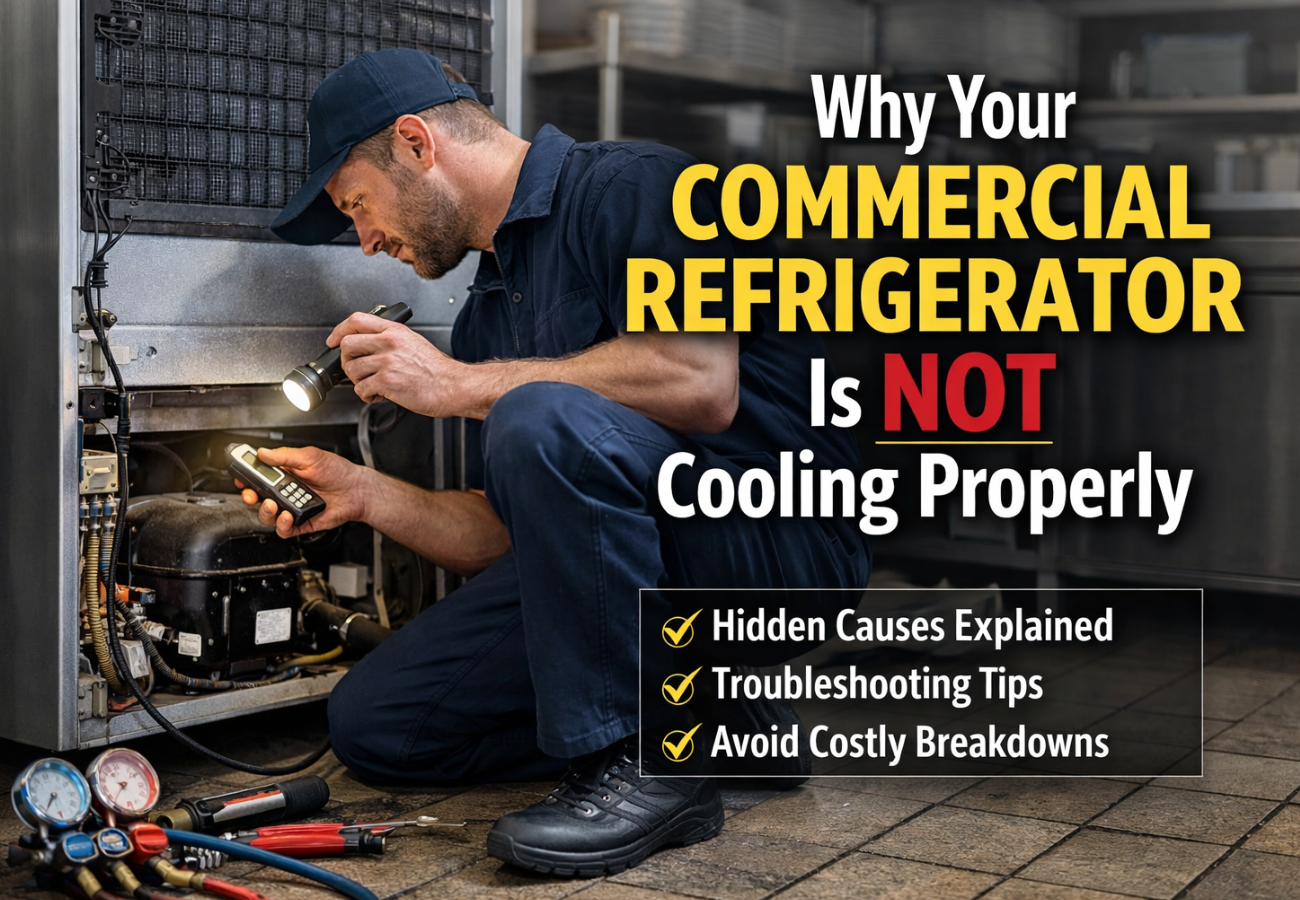
A commercial refrigerator that is running but not cooling properly is one of the most common and costly problems for businesses.
It does not just affect temperature — it directly impacts:
- Food safety
- Customer satisfaction
- Operating costs
The real issue is that most business owners do not recognize the early warning signs or the actual cause behind the problem.
In this guide, you will learn the hidden reasons your refrigerator is not cooling and what you can do to fix it before it leads to major failure.
- Dirty Condenser Coils
This is one of the most common causes of poor cooling.
In commercial environments, especially kitchens, condenser coils collect:
- Dust
- Grease
- Debris
When coils are dirty:
- Heat cannot escape properly
- The system overheats
- Cooling efficiency drops significantly
Solution:
Clean the condenser coils regularly, ideally every 1–2 months depending on usage.
- Blocked Evaporator Coils
Evaporator coils are responsible for absorbing heat inside the unit.
If airflow is restricted:
- Ice starts forming on coils
- Cooling becomes uneven
- The system runs longer than necessary
This issue develops gradually, which is why it often goes unnoticed.
- Faulty Thermostat
Sometimes the issue is not mechanical but related to temperature control.
If the thermostat is not working correctly:
- The refrigerator cannot maintain the desired temperature
- The compressor may not cycle properly
Solution:
Check and recalibrate the thermostat or replace it if needed.
- Refrigerant Gas Leak
Refrigerant is essential for cooling. If there is a leak:
- Cooling performance drops
- The compressor works harder
- Energy consumption increases
Ignoring this problem can lead to compressor damage.
Important:
Refrigerant issues must be handled by a qualified technician.
- Compressor Problems
The compressor is the core component of the refrigeration system.
If it starts failing:
- Cooling may stop completely
- The unit may produce unusual noise
- The system may overheat or shut down
Compressor issues are often expensive and should be addressed early.
- Door Seal Leakage
A damaged or loose door seal allows cold air to escape.
This leads to:
- Continuous compressor operation
- Temperature inconsistency
- Increased energy costs
Solution:
Inspect door gaskets regularly and replace them if worn out.
- Overloading the Refrigerator
Overloading is a common mistake in commercial setups.
When too many items are stored:
- Air circulation is blocked
- Cooling becomes uneven
- The system struggles to maintain temperature
Solution:
Ensure proper spacing for airflow inside the unit.
Quick Troubleshooting Checklist
Before calling a technician, check the following:
- Are the condenser coils clean?
- Is airflow inside the unit blocked?
- Are the door seals intact?
- Is the thermostat set correctly?
If the issue continues, professional inspection is recommended.
Business Impact of Ignoring Cooling Issues
Delaying repairs can lead to serious consequences:
- Food spoilage and financial loss
- Health and safety risks
- Increased electricity bills
- Unexpected equipment failure
Preventive action is always more cost-effective than emergency repairs.
Preventive Maintenance Tips
To keep your refrigeration system running efficiently:
- Schedule regular servicing every 3–6 months
- Clean coils and inspect components regularly
- Monitor temperature daily
- Avoid overloading the unit
- Ensure proper ventilation around the system
Frequently Asked Questions
Q1. Why is my commercial fridge running but not cooling?
This is usually caused by dirty coils, refrigerant issues, or airflow problems.
Q2. How often should a commercial refrigerator be serviced?
Every 3–6 months, depending on usage and environment.
Q3. Can I fix cooling issues myself?
Basic maintenance like cleaning can be done, but technical issues require a professional.
Conclusion
A commercial refrigerator that is not cooling properly is not just a technical issue — it is a business risk.
Identifying the problem early and taking the right action can save you from costly repairs, downtime, and product loss.
If your system is not performing as expected, it is best to address the issue before it escalates.